How to Be a Better Choral Singer Resource Page
Audio and text resources referred to in “How to Be a Better Choral Singer” can be found here.
Table of Contents
Concentration
Learn Sight Reading
Match Pitch: A to A# test
Test your ear with this audio clip.
The interval between any two semitones (e.g., a black key and the adjacent white key on a piano) can be further divided into 100 units called cents. You will hear
A, then a pitch 25 cents above A (i.e., adding 25 percent of the interval between A and A#)
A, then a pitch 50 cents above A (i.e., adding 50 percent of the interval between A and A#)
A, then a pitch 75 cents above A (i.e., adding 75 percent of the interval between A and A#)
A, then a pitch 100 cents above A (i.e., A#)
A
To replay the audio, first refresh this page.
Match the Pitch: Tuning apps
These four apps (and others like them) can be used to test your singing accuracy.
Singscope. http://www.singscope.com/en/. Available free for iPhone.
Nail the Pitch. Available for Android and iPhone. Free and Pro versions.
Vocal Pitch Monitor. Available free for iPhone and Android, $1.99 for iPad.
Tone. https://codalabs.io/tone. An excellent app for more advanced singers with a 7-day free trial. Available for iPhone.
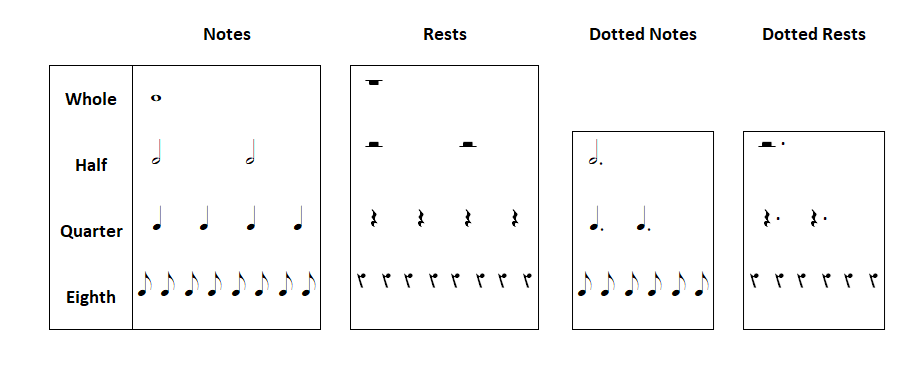
Master the Rhythms: Note and rest durations
Within each block, the rows all have the same total duration or time value.
Master the Rhythms: Three against two
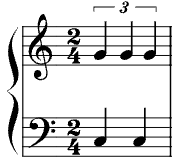
In the measure shown here, the time signature indicates two beats per measure. In the bass clef, two quarter notes supply the two beats. In the treble clef, three notes are sung in the duration of two beats.
In the audio file, you will hear the measure shown here, then two measures of the bass clef only, then measures with three notes in the treble clef against two notes in the bass clef. Try tapping along with the bass notes and, out loud, counting 1-2-3 along with the treble notes.
To replay the audio, first refresh this page.
Master the Rhythms: Two against three
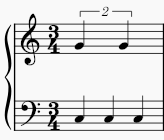
In the measure shown here, the time signature indicates three beats per measure. In the bass clef, three quarter notes supply the three beats. In the treble clef, two notes are sung in the duration of three beats.
In the audio file, you will hear the measure shown here, then two measures of the bass clef only, then measures with three notes in the treble clef against two notes in the bass clef. Try tapping along with the bass notes and, out loud, counting 1-2 along with the treble notes.
To replay the audio, first refresh this page.
Concentrate: Lifestyle for concentration
Cyrus Moulton, “Squirrel! Why attention spans seem to be shrinking and what we can do about it,” Northeastern Global News, Jan. 23, 2024, https://news.northeastern.edu/2024/01/23/decreasing-attention-span/
Jacobo Mintzer et al., “Lifestyle Choices and Brain Health,” Frontiers in Medicine 6 (2019) 204. Factors contributing to brain health include “mental well-being, exercise, cognitively stimulating activities, sleep, nutrition, and social connectedness.” https://doi.org/10.3389/fmed.2019.00204
Learn Intervals: Interval reference songs
Learn Intervals: Interval training
Two websites you can use to train your ear to hear and sing intervals.
Master Music Theory: https://music-theory-practice.com/reference/interval-reference-songs
Toned Ear: https://tonedear.com/ear-training/intervals
Learn Sight Reading: Sight reading hints
Three websites with ideas about sight reading.
University of Chicago, Department of Music. “Strategies for Successful Sight-reading!,” https://music.uchicago.edu/strategies-successful-sight-reading
Chorus America, “Improve Your Sight Reading Before Your Next Audition, https://chorusamerica.org/singers/improve-your-sight-singing-your-next-audition