In the Footsteps…
I’m sure that all of us choristers have special memories of concerts gone by at this time of year. We remember singing with our favorite directors or reflect on other nostalgic choir moments (ranging from the joy of singing our first “Hallelujah Chorus” to the tears that a tender song might provoke).
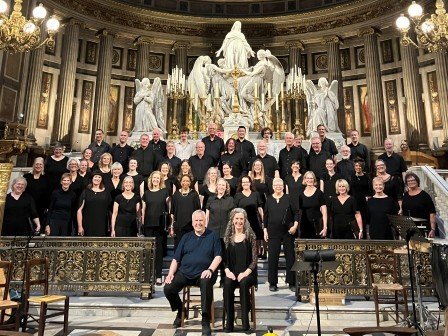
I had one of these moments this past summer at the beautiful Church of the Madeleine in Paris when our touring Concordia Choir came for a series of Bastille Day concerts.
As a college freshman farm-boy at age 17, I was introduced to a beautiful piece entitled “Cantique de Jean Racine” by Gabriel Fauré at my alma mater, the University of North Dakota. I’m sure many of us have either sung or heard the piece as it remains one his most eloquent sacred pieces.
But it was standing on the podium leading 60 wonderful singers with organ, harp, and strings last summer in a passionate performance that the gravity of it all hit me. I was surely where Fauré himself had stood, leading HIS piece that I had learned almost 50 years ago, in his amazing room with resounding acoustics and a capacity audience of over 600 people enjoying the same experience! With each chord I could feel the presence of Fauré, unfolding the ebb and flow of crescendos giving rising intensity to his perfectly composed lines. Fauré was in his late teens in 1865 when he wrote this piece in the Romantic style. He became the first choirmaster and later the organist at La Madeleine and Director of the Paris Conservatoire. (See links below.)
If there ever was a chance to be more humble than bringing this piece to life, I don’t know what it is. It’s what we do as singers. We are honest musicians—every time we pick up the folder we sing for our own enjoyment and our mental/physical health, of course, but it’s also to reach out—to communicate to others how profound this music can be! It’s ours to share!
As a conductor, I remember to always be a singer. Learning the scores, I sing every line until it fills my inner being. When I lean in to cue any section to bring out a melody, it’s with a complete sense of my own breath and passion as well, not only leading, but being at one with the singers.
They say that all conducting is chamber music. That’s true for me, I find. It is in looking at the other performers or in reaching out that we all reach a higher level above us, led by the music and its passion we all embody.
A conductor doesn’t lead, a conductor IS—“is” with the singer, the violin, the trumpet, the percussion—everything. And we make chamber music together like a string quartet or a madrigal, each contributing our own interpretation and understanding of the whole through our individual part.
One might even say, “Everything that is ever learned about conducting can be learned while singing in a madrigal quartet!”
Enjoy the holidays and please share best wishes with all for a wonderful musical world ahead in 2026!
For more information, enjoy the following website links:
Here are two contrasting performances of “Cantique de Jean Racine,” both quite beautiful:
Orchestra & Choeur Philharmonique de Strasbourg (symphonic chorus with full orchestration, singing effectively by memory).Link.
French Radio Choir with a French high school academy (organ accompaniment, fine pronunciation and good blend). Link.
Cantique de Jean Racine.Link.
Gabriel Fauré. Link.
Church of the Madeleine website (excellent site showing the church programs and photos). Link.
Church of the Madeleine (history about how it started and how it was completed in 1848). Link.
(Picture: Concordia Choir Paris Tour 2025. Victoria Gau & Stan Engebretson, co-conductors. Photo by Elisabeth Christensen, Classical Movements of Alexandria)