Music with the Masters: Robert Shaw
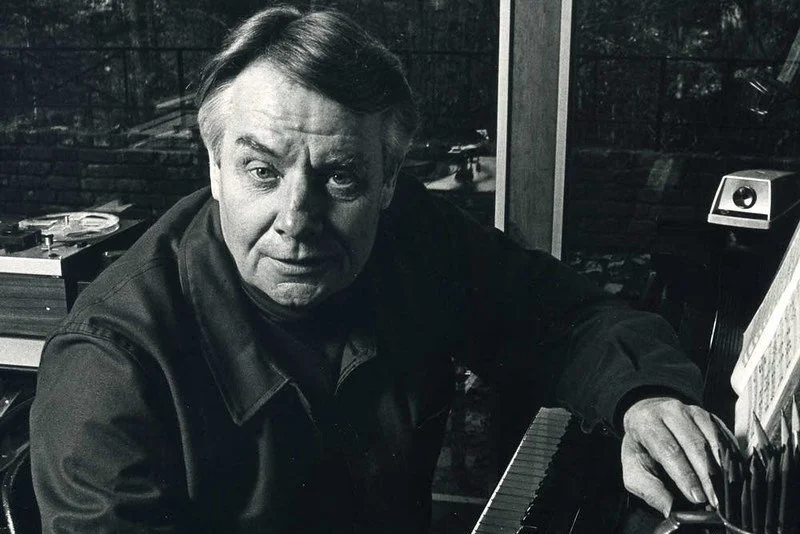
Music with the Masters: Robert Shaw
Robert Shaw is well known to my generation as one of the Great Choral Masters. He enjoyed a magnificent 50-year+ career of professional conducting. Many of us had the opportunity to sing under Mr. Shaw in various places. These experiences were a delight and did so much to inspire generations of musicians who practiced what he preached as an artist!
Shaw’s conducting career began in New York City when he organized the Fred Waring Glee Club to perform on radio. He later served as Associate Conductor with the Cleveland Orchestra and then Director of Music at the Atlanta Symphony. During these years he also organized professional choirs,, including the Robert Shaw Chorale, that recorded and toured throughout the United States and abroad.
Now already 26years after his passing, Shaw’s legacy continues to live on with many conductors, but perhaps his work is not well known to new choristers today. I would like to introduce two ways that singers might get better acquainted with Shaw. I will also discuss the distinctive rehearsal methods Shaw developed that have influenced conductors and their choruses.
Shaw as a Writer
Shaw had a rare gift for writing about choral singing. One of my colleagues who trained with Shaw, Craig Jessop from Utah State University, said of him, “I don’t know of anyone who had a greater respect for the written and spoken word than Robert Shaw.” Ann Jones, Shaw’s former assistant at the Atlanta Symphony Chorus, described him as a “wordsmith.”
Shaw’s insights and eloquence are captured in letters to his choirs. In an era before singers received weekly emails and notes in shared documents, Shaw frequently sent typewritten letters to his singers. Even though these letters covered mundane details about call times and attire, they were also a means of communicating his deep knowledge of the scores, the composers, and the poets, and underlining the sublime purpose of music. They are inspirational reading even today. Many of Shaw’s letters can be found at the Robert Shaw website. The Shaw website also offers a wealth of other information that includes a regular biography plus an “audio autobio,” discography, notes on methods, quotes, marked scores, media, film, interviews with colleagues, and more.
The Amateur Chorus
Robert Shaw’s genius was underscored by his love not only for the music but for its performers. He enjoyed working with amateur choruses as he found their dedication and love for the art to be their driving force. In a singers’ letter (October 30, 1996) he summed up his appreciation for the potential in “amateur” choirs by going back to the original Latin “amare” (to love) and “amator,” (a lover). “To borrow the metaphor, this morning’s topic is: The Arts –like Sex –are too important to leave to the professionals!”
Mr. Shaw had extensive experience leading professionals of course, but found unique qualities within the “amateur” realm that he valued. He compiled a list of the virtues of volunteer symphonic choruses, much of which applies to any amateur chorus.
1) “First,… is the participant’s personal joy, enlightenment and technical skills. No other art, to my knowledge, offers such immediate contact with the supreme achievements of human creativity. …
2) “Second would be the joy, enlightenment and inspiration given to listeners….
3) “Third is the influence a superb volunteer symphonic chorus can have on other musical organizations in its community” and on “other symphonic choruses, national and international.”
4) “The fourth virtue of the volunteer symphony chorus lies in the beauty that emerges from its struggles. “It may be precisely because we have worked so long and so hard, and with such diversity of personal backgrounds and skills, and with no recompense but those unique to amators, that we now begin to fulfill” what the composer envisioned. … “This raises the possibility that the amateur’s relationship to the Arts changes not only the lover--but also the whatever beloved.”
Shaw in Workshops
Carnegie Hall invited Shaw to lead a select group of singers in preparing and performing Brahms’s A German Requiem, and have the entire process taped. The resulting video shows Shaw rehearsing the singers and commenting. In addition to many participant testimonials, there is also a chance to hear him live in rehearsal leading the select 145-voice choir using his signature rehearsal procedures. Beginning with this 1990 program, Shaw went on to make a total of eight “Preparing a Masterpiece” recordings with Carnegie Hall. All eight videosare available on YouTube.
Rehearsal Methods
The essence of Shaw’s rehearsal method was to isolate the different element of choral singing and work on them one at a time. Singers were usually directed to rehearse at a soft dynamic. Shaw said, “We don’t want to waste vocal gold. We don’t want to wear out voices in rehearsal.” (See video at 4:55.) (Video references are to “Preparing a Masterpiece,”Vol. 1.)
“We don’t try to handle all of the choral disciplines at one and the same time,” Shaw said. “The first rehearsal should avoid complicating the learning process by trying to learn text, pronunciation, and dynamics.” (See video at 5:09.) Instead, Shaw focused first on rhythmic precision. He used a technique called count singing. Each singer would sing the notes in the piece without text. In place of text, the singer counted “one and two and tee and four and” (if the music was in 4/4 time). (See video at 17:50.) Count singing also enabled singers to unify their pitch while singing in a healthy manner.
Eventually, Shaw moved his singers from count singing to singing the text. At this stage, he rehearsed the piece without intervals or dynamics to focus on the text. Each choral section was assigned a single pitch to sing. Then all the singers would chant the text on their assigned note, following the rhythms in the score. (See video at 53:20.) Strict attention was given to pronunciation and rhythmic accuracy.
Summary
Throughout Mr. Shaw’s life he remained committed to the score and its spirit, embracing the text and seeking its true emotion to bring a work to life and not just notes on a page. He found great choral art to be gravitational, drawing humanity, as Cary Wikan wrote, “closer and closer to its own finest literature and its deepest understandings.” (Wikan p. 63). Elements of his genius included his tremendous personal dedication and energy that he put forth to create something bigger than himself. His delight was building each musician into a solid citizen in the choir, where everyone sang with the same immense dedication Mr. Shaw displayed in himself.
In one of his letters to his singers from October 25, 1961 Mr. Shaw wrote “What is required of the conductor is that he make available and attractive to his co-workers disciplines which educate – not simply dictate, to the end that each person ultimately is capable of accepting his own honest and entire musical responsibility.” “For at the final point music is sound, and you people make the sound – And the most meaningful sound in music is that which is self-disciplined, self-instructed, and self-motivated.” (October 25, 1961) His admonition for us to grow in choral singing through our own dedication and sheer hard work is a beacon and will always be remembered with joy!
(Picture: Robert Shaw (1916-1999) by TCMCTCMC)