Shape Note Singing
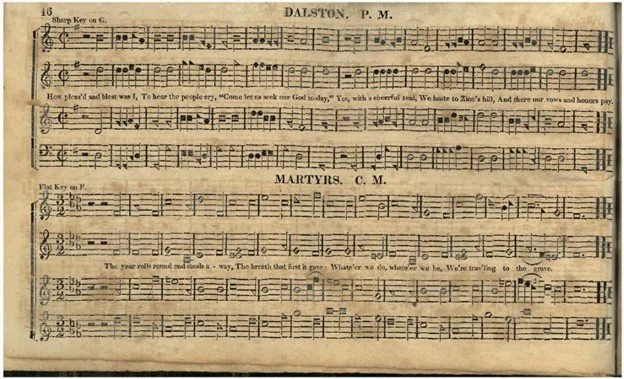
As we move into the 250th year of US heritage, we see many threads of American history coming together. American choral music has also evolved from 1776 until now with influences from all over the world, especially Europe. In the early colonies, a cappella singing was a preferred form in both secular and sacred contexts. Many traditional folk tunes were brought over by early settlers from the British Isles, and some of these songs gradually found their way into sacred music with new lyrics. For example, one of the songs we know today as “What Wondrous Love is This” was originally a pirate ballad entitled “Captain Kidd.”
Perhaps the most unique aspect of early American choral music was its reliance on “shape note singing” as a means of teaching amateurs how to read music while learning repertoire. This developed from using 4-note solfege (fa, sol, la, mi) adapted from English models dating all the way back to Shakespeare. The 4 syllables are repeated in sequence to complete the 7 tones of the major or minor scale.

In the beginning these were not “shape” notes but just solfege syllables, indicated in a 1721 Boston music book only by their first letter with dots following to show the length of the note. But around 1800, William Little and William Smith of Philadelphia devised a four-shape system of circles, squares, and triangles on different staff lines and spaces as a sight reading aid. When published in their book, The Easy Instructor, this system was rapidly adopted and became a standard means of notation.
By the mid-1800s the use of shape notes declined in the Northeast due to the influence of newer English music. However, the shape note system remained popular in the South and lower Midwest, spurred by the first edition of The Sacred Harp in 1844 and other later music collections used in singing schools and revivals.
The shape note tradition is still alive today, widely practiced by folks who gather for a “singing.” They perform these 4-note scales in solfege to solidify the music, then repeat with lyrics. The performance style is strictly prescribed with a unique, loud, full-throated sound without vibrato or bel canto influence. Singers sit within their own voice-part sections of tenor, bass, alto, and treble, facing each other in a square formation called a “hollow square.” Different members of the group rotate as leaders, standing in the middle of the square and “lead a lesson” by marking the tempo with full arm gestures that are imitated simultaneously by each member of the group to keep time while singing solfege syllables. On the second reading, lyrics are added with the same gestures. The gatherings can be all-day affairs with enjoyable camaraderie. Listen to a sample here.
The sound of this early American music is unique, as normally the melody is in the tenor part with the upper parts adding harmonies or sometimes doubling the tune at the octave. After leading out the melodies, the harmonies are usually chordal and rarely contrapuntal so the music has a raw and direct quality that is quite strong in character and fun to sing!
The sources below cite excellent online organizations that have a wealth of historical and practical information on connections to participate in groups. Take the opportunity if you can to join an early American music group first-hand to re-live our nation’s history!
Picture credits: Easy Instructor; or A New method of Teaching Sacred Harmony by William Little and William Smith, Internet Archive
C major scale: Opus33 at English Wikipedia, Public domain, via Wikimedia Commons