Alice Parker, a Melodious Accord
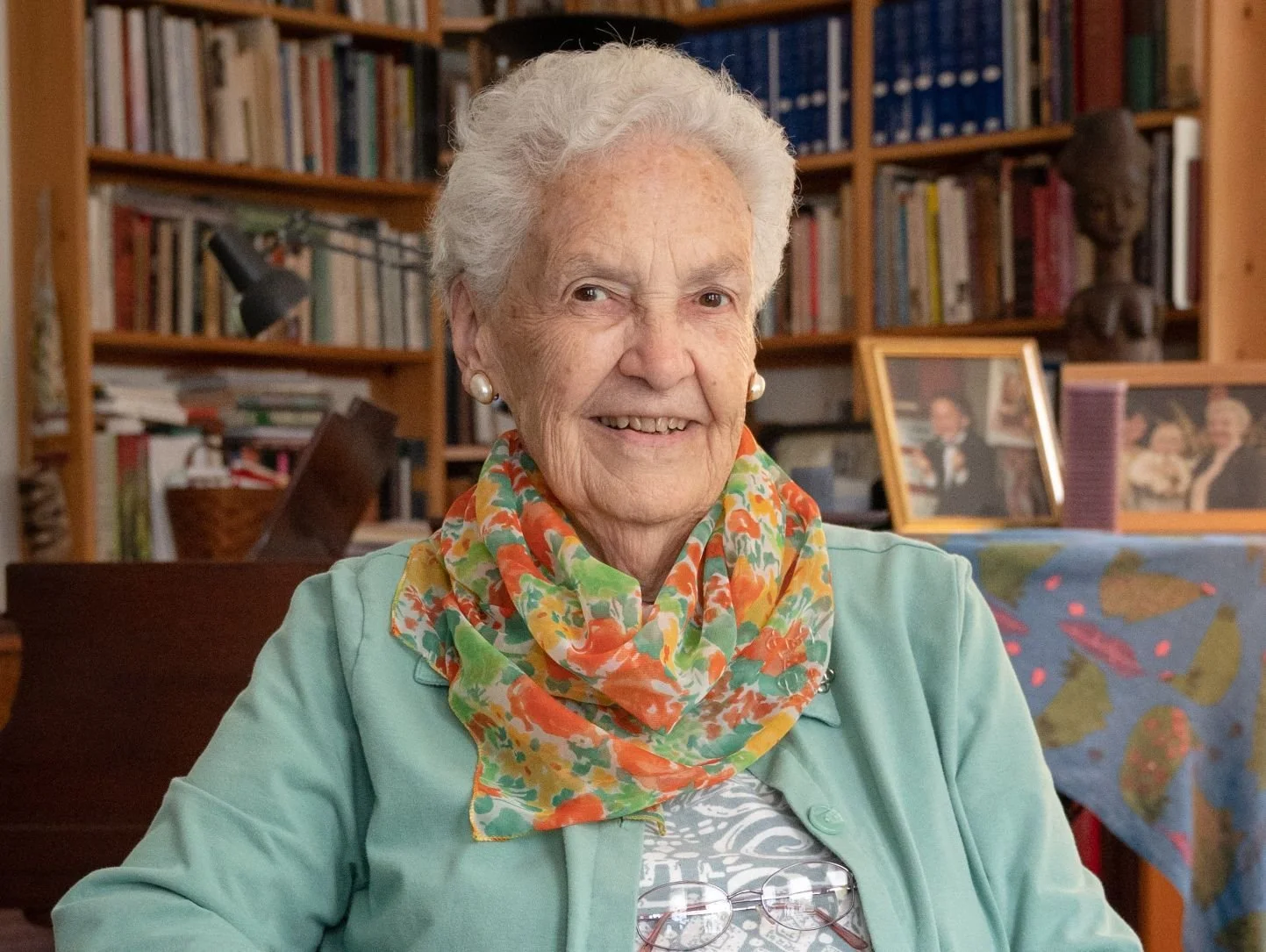
As choristers, many of us have had the opportunity to sing music set by Alice Parker (1925-2023), a world-famous composer and arranger. Alice Parker was born in Boston. She studied music theory at the New England Conservatory of Music, then transferred to Smith College where she graduated with double majors in organ and composition in 1947. Later, she studied with Robert Shaw at the Juilliard School of Music, when their choral partnership began.
Parker wrote over 200 arrangements for the RCA Victor recordings made by the Robert Shaw Chorale in New York City from 1950 to 1976. Known for her unique artistry in setting melodic lines, Parker arranged music of many genres including hymn collections, traditional American folk songs, and spirituals. Defining the “Shaw-Parker” style, the pieces were primarily four-part a cappella works that became staples of the repertoire for decades and are still widely programmed today. Titles such as “Amazing Grace,” “Hark I Hear the Harps Eternal,” and “What Wondrous Love Is This” are etched in our choral singers’ experiences. They are remarkable for their structure, the sensitive setting of the melodies, and eloquence in being accessible to average voices as well as professionals.
In addition to the hymn tunes above, Parker was given the opportunity to arrange spirituals for the Shaw recordings. A wonderful interview entitled “Spirituals: A Conversation with Alice Parker and André Thomas” is available. There she described her stylistic approach in setting her signature spirituals. Rhythm was key for her. In “John Saw Duh Numbuh,” the rhythm of the words with the open final syllables kept a driving beat going while stressing the syllables of “John” and “Num-buh.”
Equally important was the melody. She believed the melodic approach of listening and imitating the original voice as it was “sung,” not how it “was written” on the page, was the best way to find the natural flow of the line. Spirituals were originally taught in an aural tradition, so she realized that every time they were relayed there would be variants, and that was a part of the genre that she enjoyed.
In discussing the use of dialect in her arrangement of “Swing Low, Sweet Chariot” she said there is no “one” dialect, “but possibly hundreds.” She could write the syllable on the page, but knowing how to interpret the word with the correct tone, accent, stopped consonants, diphthongs and more was all governed by a lifetime of learning and repeating. She explained that a choir singing a separate or strong final “t” (“Swing low, sweeTuh Char-i-oTuh”) would never have been heard. Instead, the “t”s would be stopped or otherwise dropped, making the line more legato.
Not only an arranger, Parker was also an accomplished composer of original works. Her catalogue of over 500 compositions includes five operas, song cycles, cantatas, large works for chorus and orchestra, and 40 original hymns. Even though her studies were in composition, it wasn’t until some years after her graduation that she felt she was able to compose again. Parker set aside the atonal and serial music that was popular in the day. She found her way back through melody, which became a beacon of her style. She wrote:
I believe that melody is the foundation of human music-making, and that song issuing from one human throat is the essential first-step to a musical life. I am fascinated with the combination of words and music; therefore I have concentrated on choral and vocal works, using the very best texts that I can find. Chamber music involving small groups of voices and instruments is a favorite medium.
Parker would take a melody such as a folk song, memorize and keep singing it, adding her own interpretations until it sang with natural accents in her love of the poetry and the lyricism of the words integrated into the music. “Hearing the music when I read the poetry” became her approach, as noted in her books on melodic styles and choral improvisation. Emily Dickenson was among her favorite authors.
Upon retirement at age 70, she returned full time to Singing Brook Farm, the family property in Hawley, MA. She and a small group of friends gathered to lay out goals and make plans for establishing a small not-for-profit corporation dedicated to bringing together composers, performers, and listeners in the creation and re-creation of music This led to the formation of Melodious Accord, a 16-voice professional choir and institute, in 1985. The name expresses deeply held beliefs in melody, in the possibility of accord rather than discord. Over two decades this group made 14 recordings of various hymns and other sacred music.
In addition to her life in music, Alice Parker was deeply connected to her roots in New England and to her ideals of allowing people to sing together to create harmonious life. She was a person of deep faith and felt that this focus on singing hymn melodies together with people of all ages and backgrounds was essential for shared understanding and living well with each other.
One of her later pieces was “The Common Ground,” discussed at length in a video interview between Parker and conductor Dr. Anton Armstrong from St. Olaf College. In Colonial times, houses were built in two rows with a large common space in between where people could gather and share their stories, take care of families, and even safely herd the animals during evenings for protection if needed. It was “common ground,” to be shared by all. Parker’s wish was that we all could communicate on this even plane and stop the discord, replacing it with a “melodious accord.”
Alice Parker’s books and music are a testament to her beautiful, well-lived life and to shared human understanding through music. Today more than ever, the world needs her beautiful lessons, to “find our common ground,” and sing of our unity.