A Spiritual Legacy
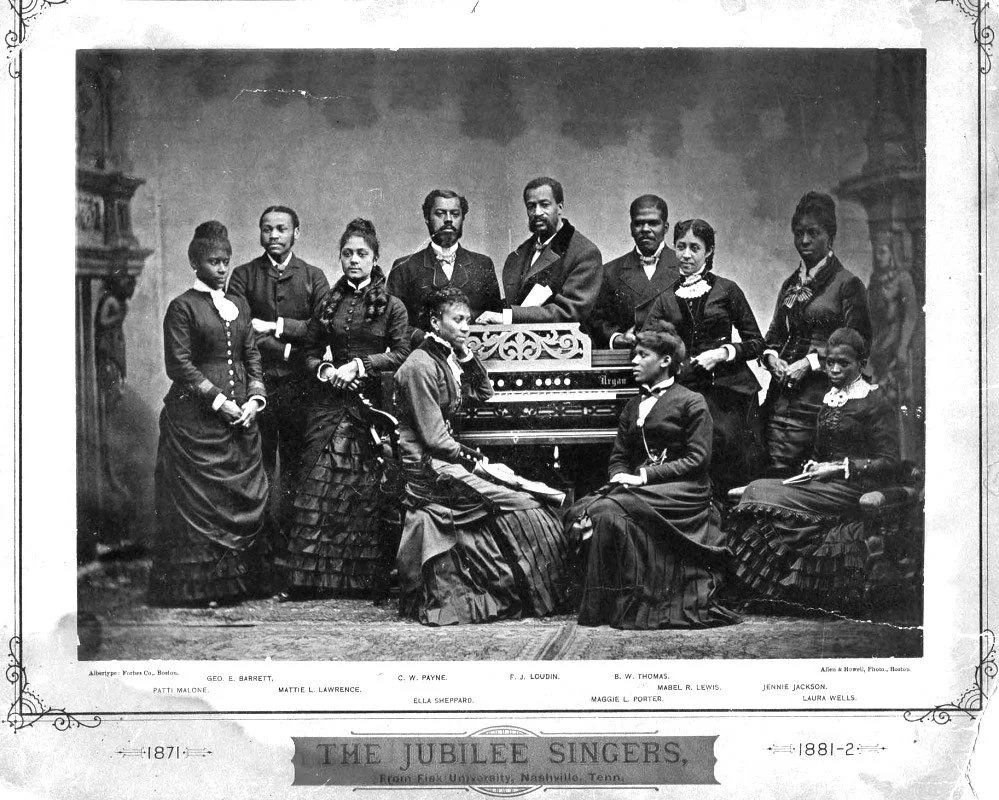
One of the delights of America’s 250th anniversary is to honor and remember the important legacies that have built our traditional choral music. A key event in preserving the original music of African-American spirituals occurred when a university that was about to go under financially created the Fisk Jubilee Singers.
Founded in Nashville in 1866 after the Civil War, Fisk University was established by missionaries as a historically black college to educate freedmen and other young African Americans. Five years later, in 1871, the school was short on funds. George Leonard White, the school’s treasurer and music director, created a 9-member touring group of 4 men and 5 women (2 mixed quartets plus a pianist) to sing concerts throughout eight Eastern states to raise money.
The tour was not easy, as racism made it difficult to secure hotels, food, and money. After a particularly long journey Mr. White found his singers exhausted, so to find encouragement he turned to Leviticus 25 to create the name “Jubilee Singers” that continues until today.*
The repertoire was primarily a cappella spirituals, but the singers found it hard in the beginning to share songs such as “Swing Low, Sweet Chariot” onstage since these were never sung in public but privately with their families in worship or at work. These musicians were not entertainers, but were more like ambassadors, showing music that was unique to their culture. Their performances brought African-American spirituals to white Northern audiences for the first time and led to their popular appreciation.
The tours became quite popular and with more concert arrangements added, continued to demonstrate the resilience of the African-American spirit in music. By 1872 they sang at the World Peace Festival in Boston and later for President Ulysses S. Grant at the White House. In 1873 the group expanded to eleven members for their tour to Great Britain where they sang “Steal Away” and “Go Down Moses” for Queen Victoria (her favorites from the program, it was reported). Later European tours raised $150,000 for Jubilee Hall at Fisk, a new campus building still standing today as a National Historical Landmark. It houses a floor-to-ceiling portrait of the original Jubilee Singers. presented as a gift from Queen Victoria.
Many different generations of the Fisk Jubilee Singers have continued until today. The current group performs an extensive concert/recording schedule with major artists. The Jubilee Singers have been honored with awards such as the Gospel Music Hall of Fame in 2000, the 2008 National Medal of Arts, and a Grammy in 2021. Samples of their music can be found here and here and a historic 1909 recording here. An a cappella musical entitled “Jubilee,” written and directed by Tazewell Thompson, premiered at Arena Stage in Washington, DC, in 2019 and is frequently presented around the country.
We all owe a great debt to these pioneers who preserved these spirituals for future generations, proving the brilliance of black composers. Their enduring legacy continues in the hands of so many of our talented contemporary composers today, honoring the tradition that will be forever blessed.
* Mr. White believed that they needed a name to capture audience attention. The next morning, he met with the singers and said “Children, it shall be Jubilee Singers in memory of the Jewish year of Jubilee.” This was a reference to Jubilee described in the book of Leviticus in the Bible. Each fiftieth Pentecost was followed by a "year of jubilee" in which all slaves would be set free. Since most of the students at Fisk University and their families were newly freed slaves, the name “Jubilee Singers” seemed fitting.
Picture credit: Deep Roots Magazine, https://commons.wikimedia.org/wiki/File:Fisk_Jubilee_Singers_1882.jpg
