Choral Movement
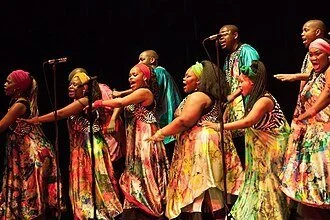
When you sing, do you stand still or do you move?
· For singers in gospel, barbershop, and show choirs, the answer is simple: “We move.” Choreographed or spontaneous movement is an essential part of the performance for these groups.
· For singers in many other types of groups, the answer may be, “It depends on what we’re singing.” For instance, a community chorus may be motionless when performing a piece by Mozart but move a lot when performing a spiritual.
· Different choruses have a different amount of movement even when performing the same piece. For example, when performing "Flight Song" by Kim André Arnesen, the BYU Singers are pretty motionless. By contrast, in a St. Olaf Choir performance of same piece, everyone is noticeably swaying. Conductor preferences and choral traditions play a big role. When singing together, the most important consideration is probably that the chorus be unified. It is distracting if one or two people move a lot while the rest of the chorus is still. Likewise, if everyone else is moving, a few stiff singers detract from the performance.
With many factors at play, there may be no single “best” answer on how much to move. Researchers have conducted experiments to study two of the elements:
1. How does movement affect how an audience perceives a choir?
2. How does movement affect the sound of a choir?
To address the first question, Jessica Nápoles and co-authors asked respondents to evaluate four different choirs singing Moses Hogan’s SATB arrangement of “Didn’t My Lord Deliver Daniel.” The researchers selected YouTube recordings of different choirs to represent four combinations of singing quality (good tone vs. poor tone) and movement (expressive vs. static). The respondents viewed the recordings and rated each group’s tone quality and general expressiveness. The respondents were able to distinguish good tone from poor tone and gave higher ratings to the choirs the researchers had selected for good tone. Comparing the ratings of the two choirs with good tone, the choir with more movement was seen as more expressive. Interestingly, between the two choirs with poor tone, the choir with more movement was considered less expressive. The researchers concluded, “When performances were not excellent, movement negatively affected ratings.”
Melissa Grady and Tianna Gilliam studied the effect of movement on choral sound quality. They used a university choir that had recently performed “Erev Shel Shoshanim,” arranged by Jack Klebanow, from memory. Singing a cappella, the choir recorded a portion of the piece three times: once standing still, again with slight swaying, and a third time with full-body swaying. Most of the singers were used to singing while standing still. In this experiment, however, the still performance had the poorest pitch accuracy and slight movement the best. Singers said they found they could sing more easily and with more expression when they moved. When listening to the three recordings, singers preferred the one with full body movement, while a panel of choral conductors preferred the version with slight movement. This study found that, on several measures, choral sound improved when the singers moved. The authors note that their “findings are limited to the particular participants and procedures of this investigation.”
Picture credit: Christine Kipper for Info Graz, CC BY 2.0 <https://creativecommons.org/licenses/by/2.0>, via Wikimedia Commons